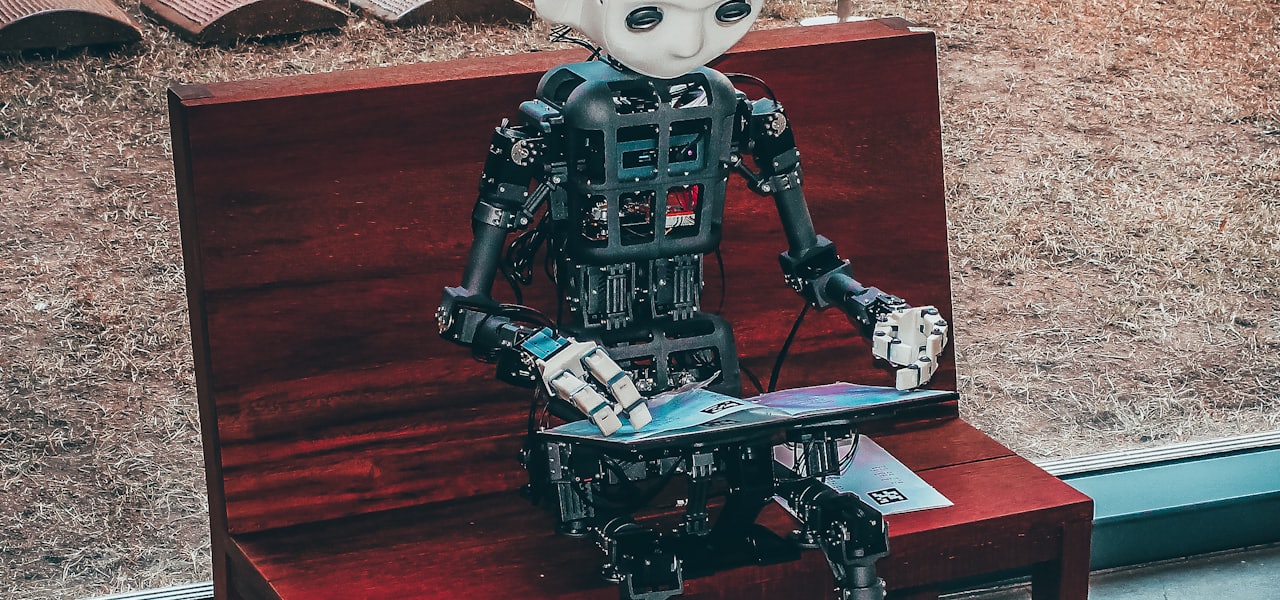
In artificial intelligence, the distributed multi-agent reasoning system (dMARS) was a platform for intelligent software agents developed at the AAII that makes uses of the belief–desire–intention software model (BDI). The design for dMARS was an extension of the intelligent agent cognitive architecture developed at SRI International called procedural reasoning system (PRS). The most recent incarnation of this framework is the JACK Intelligent Agents platform. == Overview == dMARS was an agent-oriented development and implementation environment written in C++ for building complex, distributed, time-critical systems.
BigDog
BigDog is a dynamically stable quadruped military robot platform that was created in 2005 by Boston Dynamics with the Harvard University Concord Field Station. It was funded by the U.S. Defense Advanced Research Projects Agency (DARPA), but the project was shelved after the BigDog's gas engine was deemed too loud for combat. == History == BigDog was funded by the Defense Advanced Research Projects Agency (DARPA) in the hopes that it would be able to serve as a mechanic pack mule to accompany soldiers in terrain too rough for conventional vehicles. Instead of wheels or treads, BigDog uses four legs for movement, allowing it to move across surfaces that would be difficult for wheels. The legs contain a variety of sensors, including joint position and ground contact. BigDog also features a laser gyroscope and a stereo vision system. BigDog is 3 feet (0.91 m) long, stands 2.5 feet (0.76 m) tall, and weighs 240 pounds (110 kg), making it about the size of a small mule. It is capable of traversing difficult terrain, running at four miles per hour (6.4 km/h), carrying 340 pounds (150 kg), and climbing a 35 degree incline. Locomotion is controlled by an onboard computer that receives input from the robot's various sensors. Navigation and balance are also managed by the control system. BigDog's walking pattern is controlled through four legs, each equipped with four low-friction hydraulic cylinder actuators that power the joints. BigDog's locomotion behaviors can vary greatly. It can stand up, sit down, walk with a crawling gait that lifts one leg at a time, walk with a trotting gait lifting diagonal legs, or trot with a running gait. The travel speed of BigDog varies from a 0.62 mph (1 km/h) crawl to a 3.3 mph (5.3 km/h) trot. The BigDog project was headed by Dr. Martin Buehler, who received the Joseph Engelberger Award from the Robotics Industries Association in 2012 for the work. Dr. Buehler while previously a professor at McGill University, headed the robotics lab there, developing four-legged walking and running robots. Built onto the actuators are sensors for joint position and force, and movement is ultimately controlled through an onboard computer which manages the sensors. Approximately 50 sensors are located on BigDog. These measure the attitude and acceleration of the body, motion, and force of joint actuators as well as engine speed, temperature and hydraulic pressure inside the robot's internal engine. Low-level control, such as position and force of the joints, and high-level control such as velocity and altitude during locomotion, are both controlled through the onboard computer. BigDog was featured in episodes of Web Junk 20 and Hungry Beast, and in articles in New Scientist, Popular Science, Popular Mechanics, and The Wall Street Journal. In September 2011 Boston Dynamics released video footage of a new generation of BigDog known as AlphaDog. The footage shows AlphaDog's ability to walk on rough terrain and recover its balance when kicked from the side. The refined equivalent has been designed by Boston Dynamics to exceed the BigDog in terms of capabilities and use to dismounted soldiers. In February 2012, with further DARPA support, the militarized Legged Squad Support System (LS3) variant of BigDog demonstrated its capabilities during a hike over a rough terrain. Starting in the summer of 2012, DARPA planned to complete the overall development of the system and refine its key capabilities in 18 months, ensuring its worth to dismounted warfighters before it is rolled out to squads operating in-theatre. BigDog must be able to demonstrate its ability to complete a 20-mile (32 km) trail in 24 hours, without refuelling, while carrying a 325-pound (150 kg) load. A refinement of its vision sensors will also be conducted. At the end of February 2013, Boston Dynamics released video footage of a modified BigDog with an arm. The arm could pick up objects and throw them. The robot is relying on its legs and torso to help power the motions of the arm. It is believed that it can lift weights around 55 pounds (25 kg). This work was funded by the United States Army Research Laboratory and paved the way for integrating manipulators with quadrupeds as found on Spot, the spiritual successor of BigDog. === Discontinuation === At the end of December 2013, the BigDog project was discontinued. Despite hopes that it would one day work like a pack mule for US soldiers in the field, the gasoline-powered engine was deemed too noisy for use in combat, and it could be heard from hundreds of meters away. A similar project for an all-electric robot named Spot in 2016 was much quieter, but could only carry 45 pounds (20 kg). Both projects are no longer in progress, but the Spot was only released in 2020. == Hardware == BigDog is powered by a small two-stroke, one-cylinder, 15-brake-horsepower (11 kW) engine operating at 9,000 RPM. The engine drives a hydraulic pump, which in turn drives the hydraulic leg actuators. Each leg has four actuators (two for the hip joint, and two each for the knee and ankle joints), for a total of 16. Each actuator unit consists of a hydraulic cylinder, servo valve, position sensor, and force sensor. Onboard computing power is a ruggedized PC/104 board stack with two computers, one running a Pentium M processor running QNX (used for sensor data processing) and another running a Core Duo processor (used for visual data processing). == Gallery ==
Kaggle
Kaggle is a data science competition platform and online community for data scientists and machine learning practitioners under Google LLC. Kaggle enables users to find and publish datasets, explore and build models in a web-based data science environment, work with other data scientists and machine learning engineers, and enter competitions to solve data science challenges. Kaggle has also facilitated the use of unethical and unreliable data in medical research. == History == Kaggle was founded by Anthony Goldbloom in April 2010. Jeremy Howard, one of the first Kaggle users, joined in November 2010 and served as the President and Chief Scientist. Also on the team was Nicholas Gruen serving as the founding chair. In 2011, the company raised $12.5 million and Max Levchin became the chairman. On March 8, 2017, Fei-Fei Li, Chief Scientist at Google, announced that Google was acquiring Kaggle. In June 2017, Kaggle surpassed 1 million registered users, and as of October 2023, it has over 15 million users in 194 countries. In 2022, founders Goldbloom and Hamner stepped down from their positions and D. Sculley became the CEO. In February 2023, Kaggle introduced Models, allowing users to discover and use pre-trained models through deep integrations with the rest of Kaggle’s platform. In April 2025, Kaggle partnered with Wikimedia Foundation. == Site overview == === Competitions === Many machine-learning competitions have been run on Kaggle since the company was founded. Notable competitions include gesture recognition for Microsoft Kinect, making a association football AI for Manchester City, coding a trading algorithm for Two Sigma Investments, and improving the search for the Higgs boson at CERN. The competition host prepares the data and a description of the problem; the host may choose whether it's going to be rewarded with money or be unpaid. Participants experiment with different techniques and compete against each other to produce the best models. Work is shared publicly through Kaggle Kernels to achieve a better benchmark and to inspire new ideas. Submissions can be made through Kaggle Kernels, via manual upload or using the Kaggle API. For most competitions, submissions are scored immediately (based on their predictive accuracy relative to a hidden solution file) and summarized on a live leaderboard. After the deadline passes, the competition host pays the prize money in exchange for "a worldwide, perpetual, irrevocable and royalty-free license [...] to use the winning Entry", i.e. the algorithm, software and related intellectual property developed, which is "non-exclusive unless otherwise specified". Alongside its public competitions, Kaggle also offers private competitions, which are limited to Kaggle's top participants. Kaggle offers a free tool for data science teachers to run academic machine-learning competitions. Kaggle also hosts recruiting competitions in which data scientists compete for a chance to interview at leading data science companies like Facebook, Winton Capital, and Walmart. Kaggle's competitions have resulted in successful projects such as furthering HIV research, chess ratings and traffic forecasting. Geoffrey Hinton and George Dahl used deep neural networks to win a competition hosted by Merck. Vlad Mnih (one of Hinton's students) used deep neural networks to win a competition hosted by Adzuna. This resulted in the technique being taken up by others in the Kaggle community. Tianqi Chen from the University of Washington also used Kaggle to show the power of XGBoost, which has since replaced Random Forest as one of the main methods used to win Kaggle competitions. Several academic papers have been published based on findings from Kaggle competitions. A contributor to this is the live leaderboard, which encourages participants to continue innovating beyond existing best practices. The winning methods are frequently written on the Kaggle Winner's Blog. === Progression system === Kaggle has implemented a progression system to recognize and reward users based on their contributions and achievements within the platform. This system consists of five tiers: Novice, Contributor, Expert, Master, and Grandmaster. Each tier is achieved by meeting specific criteria in competitions, datasets, kernels (code-sharing), and discussions. The highest tier, Kaggle Grandmaster, is awarded to users who have ranked at the top of multiple competitions including high ranking in a solo team. As of April 2, 2025, out of 23.29 million Kaggle accounts, 2,973 have achieved Kaggle Master status and 612 have achieved Kaggle Grandmaster status. === Kaggle Notebooks === Kaggle includes a free, browser-based online integrated development environment, called Kaggle Notebooks, designed for data science and machine learning. Users can write and execute code in Python or R, import datasets, use popular libraries, and train models on CPUs, GPUs, or TPUs directly in the cloud. This environment is often used for competition submissions, tutorials, education, and exploratory data analysis. == Medical Research Problems == In December 2025, an article was published in The Transmitter titled "Exclusive: Springer Nature retracts, removes nearly 40 publications that trained neural networks on ‘bonkers’ dataset". The dataset in question was uploaded to Kaggle containing photographs of autistic and non-autistic children's faces. This dataset contained more than 2,900 images and it is unlikely that these children or their families gave consent for the photos for use in medical research or the images were ethically approved for research. The articles using the dataset in Springer Nature were retracted from the scientific literature. At least 90 other publications cite a version of the dataset. In April 2026, another two datasets were identified on Kaggle with no data provenance having been published in Nature titled: "Dozens of AI disease-prediction models were trained on dubious data". These datasets were used in 124 clinical prediction models, at least two of which have been used in hospitals in Indonesia and Spain, while one article using the dataset was referenced in a medical device patent. As of April 17, 2026, three of the articles using these datasets have been retracted from the scientific literature. In May 2026, an additional research publication using two image datasets from Kaggle is under investigation in Scientific Reports. An article in Retraction Watch "‘Comically bad’ datasets used to train clinical models for stroke and diabetes" highlighted the images included famous actors such as Sylvester Stallone as Rambo, George Clooney, Angelina Jolie and Daniel Craig as well as children. It would be unethical for the use of these child images in medical research without consent. Reverse searching images saw some of the images were not for stroke but for bell's palsy. One of the datasets is no longer available on Kaggle while the other one still remains and mentions the images may be subject to copyright. Kaggle relies on the community self-reporting metadata and provenance and mentions the stroke and diabetes dataset identified in "Evidence of unreliable data and poor data provenance in clinical prediction model research and clinical practice" does not violate their terms of service and they would have been removed if they had.
ML.NET
ML.NET is a free software machine learning library for the C# and F# programming languages. It also supports Python models when used together with NimbusML. The preview release of ML.NET included transforms for feature engineering like n-gram creation, and learners to handle binary classification, multi-class classification, and regression tasks. Additional ML tasks like anomaly detection and recommendation systems have since been added, and other approaches like deep learning will be included in future versions. == Machine learning == ML.NET brings model-based Machine Learning analytic and prediction capabilities to existing .NET developers. The framework is built upon .NET Core and .NET Standard inheriting the ability to run cross-platform on Linux, Windows and macOS. Although the ML.NET framework is new, its origins began in 2002 as a Microsoft Research project named TMSN (text mining search and navigation) for use internally within Microsoft products. It was later renamed to TLC (the learning code) around 2011. ML.NET was derived from the TLC library and has largely surpassed its parent says Dr. James McCaffrey, Microsoft Research. Developers can train a Machine Learning Model or reuse an existing Model by a 3rd party and run it on any environment offline. This means developers do not need to have a background in Data Science to use the framework. Support for the open-source Open Neural Network Exchange (ONNX) Deep Learning model format was introduced from build 0.3 in ML.NET. The release included other notable enhancements such as Factorization Machines, LightGBM, Ensembles, LightLDA transform and OVA. The ML.NET integration of TensorFlow is enabled from the 0.5 release. Support for x86 & x64 applications was added to build 0.7 including enhanced recommendation capabilities with Matrix Factorization. A full roadmap of planned features have been made available on the official GitHub repo. The first stable 1.0 release of the framework was announced at Build (developer conference) 2019. It included the addition of a Model Builder tool and AutoML (Automated Machine Learning) capabilities. Build 1.3.1 introduced a preview of Deep Neural Network training using C# bindings for Tensorflow and a Database loader which enables model training on databases. The 1.4.0 preview added ML.NET scoring on ARM processors and Deep Neural Network training with GPU's for Windows and Linux. === Performance === Microsoft's paper on machine learning with ML.NET demonstrated it is capable of training sentiment analysis models using large datasets while achieving high accuracy. Its results showed 95% accuracy on Amazon's 9GB review dataset. === Model builder === The ML.NET CLI is a Command-line interface which uses ML.NET AutoML to perform model training and pick the best algorithm for the data. The ML.NET Model Builder preview is an extension for Visual Studio that uses ML.NET CLI and ML.NET AutoML to output the best ML.NET Model using a GUI. === Model explainability === AI fairness and explainability has been an area of debate for AI Ethicists in recent years. A major issue for Machine Learning applications is the black box effect where end users and the developers of an application are unsure of how an algorithm came to a decision or whether the dataset contains bias. Build 0.8 included model explainability API's that had been used internally in Microsoft. It added the capability to understand the feature importance of models with the addition of 'Overall Feature Importance' and 'Generalized Additive Models'. When there are several variables that contribute to the overall score, it is possible to see a breakdown of each variable and which features had the most impact on the final score. The official documentation demonstrates that the scoring metrics can be output for debugging purposes. During training & debugging of a model, developers can preview and inspect live filtered data. This is possible using the Visual Studio DataView tools. === Infer.NET === Microsoft Research announced the popular Infer.NET model-based machine learning framework used for research in academic institutions since 2008 has been released open source and is now part of the ML.NET framework. The Infer.NET framework utilises probabilistic programming to describe probabilistic models which has the added advantage of interpretability. The Infer.NET namespace has since been changed to Microsoft.ML.Probabilistic consistent with ML.NET namespaces. === NimbusML Python support === Microsoft acknowledged that the Python programming language is popular with Data Scientists, so it has introduced NimbusML the experimental Python bindings for ML.NET. This enables users to train and use machine learning models in Python. It was made open source similar to Infer.NET. === Machine learning in the browser === ML.NET allows users to export trained models to the Open Neural Network Exchange (ONNX) format. This establishes an opportunity to use models in different environments that don't use ML.NET. It would be possible to run these models in the client side of a browser using ONNX.js, a JavaScript client-side framework for deep learning models created in the Onnx format. === AI School Machine Learning Course === Along with the rollout of the ML.NET preview, Microsoft rolled out free AI tutorials and courses to help developers understand techniques needed to work with the framework.
Alex Krizhevsky
Alex Krizhevsky is a Canadian computer scientist most noted for his work on artificial neural networks and deep learning. In 2012, Krizhevsky, Ilya Sutskever and their PhD advisor Geoffrey Hinton, at the University of Toronto, developed a powerful visual-recognition network AlexNet using only two GeForce-branded GPU cards. This revolutionized research in neural networks. Previously neural networks were trained on CPUs. The transition to GPUs opened the way to the development of advanced AI models. == AlexNet == Motivated by Sutskever and inspired by Hinton, Krizhevsky developed AlexNet to expand the limits in image recognition and classification. Building on Convolutional Neural Networks and Sutskever’s Deep Neural Network approach of deepening the neural layers far beyond the convention of the time—as well as adding Dropout for training resilience—AlexNet won the ImageNet challenge in 2012. The team presented their paper for AlexNet at NeurIPS (NIPS) 2012. Shortly after AlexNet’s debut, Krizhevsky and Sutskever sold their startup, DNN Research Inc., to Google. Krizhevsky left Google in September 2017 after losing interest in the work, to work at the company Dessa in support of new deep-learning techniques. Many of his numerous papers on machine learning and computer vision are frequently cited by other researchers. He is also the main author of the CIFAR-10 and CIFAR-100 datasets. == Legacy == AlexNet is widely credited with igniting the deep learning revolution. Its success demonstrated the effectiveness of deep neural networks trained on GPUs, leading to rapid progress across multiple domains of artificial intelligence beyond computer vision. The techniques and momentum generated by AlexNet helped shape the development of modern natural language processing models, including large-scale transformer-based models such as BERT and GPT, which power tools like ChatGPT.
Patent visualisation
Patent visualisation is an application of information visualisation. The number of patents has been increasing, encouraging companies to consider intellectual property as a part of their strategy. Patent visualisation, like patent mapping, is used to quickly view a patent portfolio. Software dedicated to patent visualisation began to appear in 2000, for example Aureka from Aurigin (now owned by Thomson Reuters). Many patent and portfolio analytics platforms, such as Questel, Patent Forecast, PatSnap, Patentcloud, Relecura, and Patent iNSIGHT Pro, offer options to visualise specific data within patent documents by creating topic maps, priority maps, IP Landscape reports, etc. Software converts patents into infographics or maps, to allow the analyst to "get insight into the data" and draw conclusions. Also called patinformatics, it is the "science of analysing patent information to discover relationships and trends that would be difficult to see when working with patent documents on a one-and-one basis". Patents contain structured data (like publication numbers) and unstructured text (like title, abstract, claims and visual info). Structured data are processed by data-mining and unstructured data are processed with text-mining. == Data mining == The main step in processing structured information is data-mining, which emerged in the late 1980s. Data mining involves statistics, artificial intelligence, and machine learning. Patent data mining extracts information from the structured data of the patent document. These structured data are bibliographic fields such as location, date or status. === Structured fields === === Advantages === Data mining allows study of filing patterns of competitors and locates main patent filers within a specific area of technology. This approach can be helpful to monitor competitors' environments, moves and innovation trends and gives a macro view of a technology status. == Text-mining == === Principle === Text mining is used to search through unstructured text documents. This technique is widely used on the Internet, it has had success in bioinformatics and now in the intellectual property environment. Text mining is based on a statistical analysis of word recurrence in a corpus. An algorithm extracts words and expressions from title, summary and claims and gathers them by declension. "And" and "if" are labeled as non-information bearing words and are stored in the stopword list. Stoplists can be specialised in order to create an accurate analysis. Next, the algorithm ranks the words by weight, according to their frequency in the patent's corpus and the document frequency containing this word. The score for each word is calculated using a formula such as: W e i g h t = T e r m F r e q u e n c y D o c u m e n t F r e q u e n c y = F r e q u e n c y o f t h e w o r d o r e x p r e s s i o n i n t h e T e x t S e a N u m b e r o f d o c u m e n t s c o n t a i n i n g t h e e x p r e s s i o n o r w o r d {\displaystyle Weight={\frac {Term\ Frequency}{Document\ Frequency}}={\frac {Frequency\ of\ the\ word\ or\ expression\ in\ the\ Text\ Sea}{Number\ of\ documents\ containing\ the\ expression\ or\ word}}} A frequently used word in several documents has less weight than a word used frequently in a few patents. Words under a minimum weight are eliminated, leaving a list of pertinent words or descriptors. Each patent is associated to the descriptors found in the selected document. Further, in the process of clusterisation, these descriptors are used as subsets, in which the patent are regrouped or as tags to place the patents in predetermined categories, for example keywords from International Patent Classifications. Four text parts can be processed with text-mining : Title Abstract Claim Patent Full-Text Software offer different combinations but title, abstract and claim are generally the most used, providing a good balance between interferences and relevancy. === Advantages === Text-mining can be used to narrow a search or quickly evaluate a patent corpus. For instance, if a query produces irrelevant documents, a multi-level clustering hierarchy identifies them in order to delete them and refine the search. Text-mining can also be used to create internal taxonomies specific to a corpus for possible mapping. == Visualisations == Allying patent analysis and informatic tools offers an overview of the environment through value-added visualisations. As patents contain structured and unstructured information, visualisations fall in two categories. Structured data can be rendered with data mining in macrothematic maps and statistical analysis. Unstructured information can be shown in like clouds, cluster maps and 2D keyword maps. === Data mining visualisation === === Text mining visualisation === === Visualisation for both data-mining and text-mining === Mapping visualisations can be used for both text-mining and data-mining results. == Uses == What patent visualisation can highlight: Competitors Partners New innovations Technologic environment description Networks Field application: R&D strategy management Competitive intelligence Licensing Strategy
Semantic knowledge management
In computer science, semantic knowledge management is a set of practices that seeks to classify content so that the knowledge it contains may be immediately accessed and transformed for delivery to the desired audience, in the required format. This classification of content is semantic in its nature – identifying content by its type or meaning within the content itself and via external, descriptive metadata – and is achieved by employing XML technologies. The specific outcomes of these practices are: Maintain content for multiple audiences together in a single document Transform content into various delivery formats without re-authoring Search for content more effectively Involve more subject-matter experts in the creation of content without reducing quality Reduce production costs for delivery formats Reduce the manual administration of getting the right knowledge to the right people Reduce the cost and time to localize content == Notable semantic knowledge management systems == Learn eXact Thinking Cap LCMS Thinking Cap LMS Xyleme LCMS iMapping